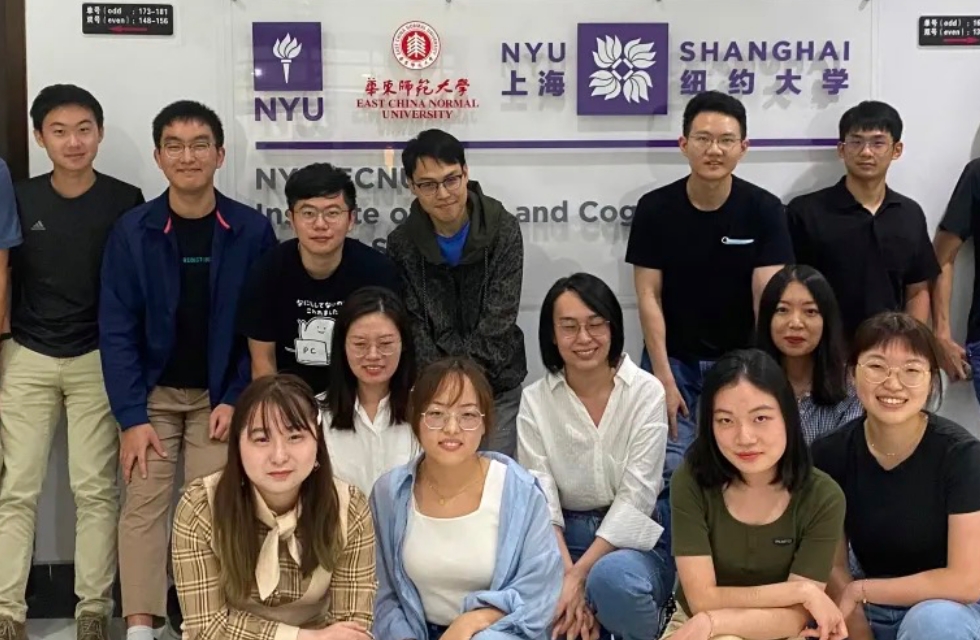


Investigating cognitive functions of the brain is one of the many research focuses at NYU Shanghai. Taking full advantage of NYU Shanghai’s interdisciplinary environment and making creative use of diverse research tools, young scientists at NYU Shanghai extended their research work to the frontiers of global academia to create a new model of graduate student training, The NYU Shanghai-ECNU Joint Graduate Training Program (N.E.T.).
Established jointly by NYU Shanghai and ECNU, N.E.T enables its students to benefit from the rich educational, research, and network resources available from both institutions. Students communicate directly with and work alongside distinguished scholars from all over the world, access cutting-edge research tools, and expand their academic horizons to advance the future of their scientific research. Want to learn more about cognitive neuroscience and explore the mysteries of human speech and language? Let’s take a closer look at Professor Tian’s SLANG laboratory to learn more about the unique research environment and innovative culture it provides for its students.
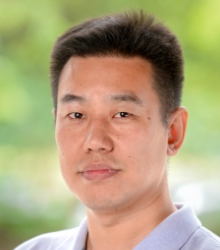
Professor Xing Tian
Xing Tian is an Assistant Professor of Neural and Cognitive Sciences at NYU Shanghai, Global Network Assistant Professor at NYU, and a core member of the NYU-ECNU Institute of Brain and Cognitive Science at NYU Shanghai. Prior to joining NYU Shanghai, he was a Postdoctoral Fellow at NYU. He holds a PhD in Neuroscience and Cognitive Science from the University of Maryland, College Park and a BS in Physics from Peking University.
Professor Tian’s research focuses on how the interaction between action and perception underlies speech, language, memory and other higher-level cognition. He started the Speech, Language and Neuroscience Group (SLANG) after he joined NYU Shanghai.
The Speech, Language and Neuroscience Group (SLANG)
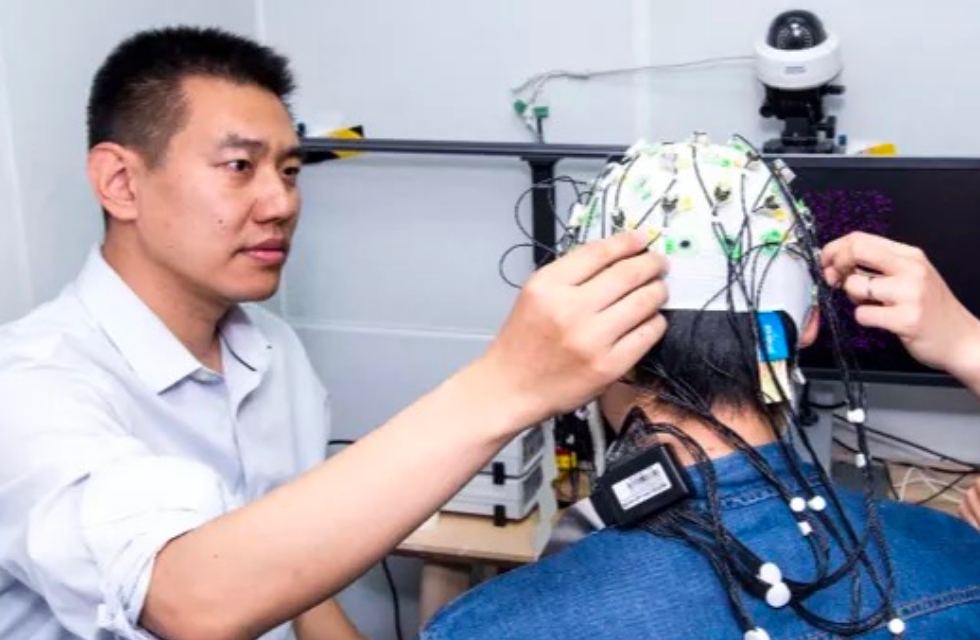
Speech is the most fundamental part of everyday communication. To effectively exchange information, speech requires us to constantly receive and produce sounds, which in turn demands a highly effective interface between perception and production. For Professor Tian and his team, speech and language are models to investigate the neural computations underlying human cognition. Using electrophysiological (MEG/EEG/ECoG) and neuroimaging (fMRI) techniques with behavioral and computational approaches, SLANG investigates the function of motor sensory interactions that are at the core of the speech perception-production control loop, as well as their relation to language, learning, memory, mental imagery, and other higher order cognitive functions. The research results of the group have been published in international journals such as Nature Human Behaviour, Nature Neuroscience, Current Biology, PLOS Biology, Psychological Science, Cerebral Cortex, Cognition, Cognitive Psychology and others.
Research Highlights
The research team has formed a new understanding of speech, language, and motor sensory interaction. In the domain of neuroscience research, the research team used a novel delayed articulation paradigm combined with EEG recording to, for the first time, prove that functionally distinct motor signals were generated in motor-to-sensory transformation and integrated with sensory inputs to modulate perception during speech preparation. The result was published in the field’s core journal Cerebral Cortex.
In the domain of cognitive research, using magnetoencephalographic technology and a novel imagery-perception repetition paradigm, the laboratory was the first to accurately reveal the motor-to-sensory transformation neural network and its dynamics, proving for the first time that speech imagery can be extended to the primary auditory cortex and affect perception. Related research results were published in the top international journals PLOS Biology and Nature Human Behaviour.
In a more practical study, the team collaborated with the University of Chicago in research that examined how gestures can be an effective way to help native English speakers learn Mandarin tones. The result was published in the field’s core journal Cognition.
In addition, the group cooperated with the Max Planck Institute for Empirical Aesthetics in Germany to jointly explore the neural processing mechanisms of individuals experiencing ancient Chinese poetry. They found that special rhythmic neural oscillations in the human brain track poetic sentences and semantic cohorts. This result further reveals the neurodynamic mechanism of speech processing on a larger scale. The findings were published in the top international journal, Current Biology.
The Culture of SLANG and Student Research Experience
In building its interdisciplinary research team in cognitive neuroscience, SLANG fundamentally embodies a people-centered culture. Over the past 5 years, the lab has accepted dozens of new researchers from various academic levels including undergraduates, full-time research assistants, graduate students, doctoral students, and post-doctoral researchers. SLANG researchers come from a variety of majors, including physics, mathematics, computer science, data science, psychology, linguistics, audiology, psychiatry, architecture, accounting and more. Over the past three years, researchers at SLANG–many of whom graduated and successively went on to continue their studies at Harvard, Yale, Columbia, The California Institute of Technology, The Max Planck Institute for Psycholinguistics and other well-known international universities and research institutes–have published 12 articles. The lab does not judge people based on their backgrounds, but values more the interest, strength, ideas, goals, plans, and determination that candidates demonstrate to enter the field of cognitive neuroscience, a field full of promise and challenge.
Accelerating Innovative Research
The lab’s main research direction is the exploration of speech, language, memory, and other advanced cognitive functions from the perspective of motor sensory interaction, determined by the broad scope of researchers’ explorations of human cognition. Research directions at SLANG can be described as, "closely aligned with the main direction yet all-encompassing." Topics range from basic perception, motor control, and speech production, to advanced functions such as language, memory, and mental imagery. Topics also extend over to practical learning, education, artificial intelligence, clinical-related research such as schizophrenia and auditory hallucinations, aesthetics and the arts (including music, poetry, and traditional Chinese culture). We should also mention that most of these research projects are independently proposed and carried out by students wishing to combine their own interests with the overall research goals of the lab.
These extensive, comprehensive, novel and cutting-edge research topics are supported by the adequate resources of the laboratory, which includes equipment commonly used in cognitive neuroscience research such as electroencephalographic and magnetic resonance imaging equipment. Researchers also have the opportunity to work in cooperation with scientific research institutions and hospitals in Beijing, New York, and other locations to gain experience with magnetoencephalography and intracranial EEG recordings. The lab also collaborates with researchers in mental health centers conducting studies of individuals with mental illness, as well as with computer scientists building computational models and implementing quantitative methods.
The diverse scientific research experiences and backgrounds of researchers at SLANG engenders a positive atmosphere for group discussion, learning, cooperation and of course, the lab also encourages and supports innovative, independent scientific research. Combining East China Normal University and NYU Shanghai’s special “twin campuses,” SLANG provides its personnel with a harmonious, comprehensive, interdisciplinary working and learning environment filled with potential.