


This year marks the establishment of NYU Shanghai’s first annual series of N.E.T. Awards for Academic Excellence. The N.E.T. Award for academic excellence aims to stimulate students’ progress in academic research and recognize students who have made outstanding achievements in their work. From a competitive pool of talented applicants, 5 recipients were selected across disciplines.
Recently, the N.E.T. Program Award Committee is honored to announce ECNU Ph.D. candidate Zhiwei Liu as this year’s recipient of the new N.E.T. Award for Academic Excellence. According to Liu, the N.E.T. Award represents “an affirmation of my hard work in scientific research over the past two years” and he is excited to continue his progress as a researcher.
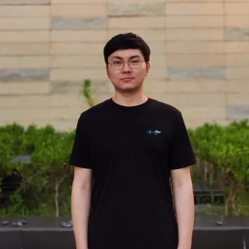
Zhiwei Liu
NYU Shanghai - ECNU Joint Graduate Training Program (N.E.T.)
PhD candidate in physical electronics
Zhiwei Liu is an active member of the N.E.T. community and a researcher in the field of Physics and Nanotechnology supporting Assistant Professor of Physics Hanghui Chen. Liu is the first co-author of work published in PNAS exploring properties of Berry curvature in a quantum material, and in his current work published as a first co-author this year in ACS Nano offers insights into the soft ferromagnetism of the LaMnO3 system.
What is the current focus of your research? Is there a particular lab you are affiliated with? Who has most influenced you in your work?
I am a member of Professor Hanghui Chen's team and I’ve completed two projects recently. For the first project, I worked with my faculty advisor and the research team from Tsinghua University. Using theoretical and experimental physics approaches, we conducted an in-depth study of a special physical property called Berry curvature of the quantum material SrRuO3. Our research article was published in PNAS. My other project is the study of the soft ferromagnetism of the LaMnO3 system and that research was published recently in the journal ACS Nano. I am currently working on several projects with Professor Chen.
Can you describe the support and mentorship that you have received from your faculty advisors?
All of my projects were completed under the guidance of my faculty advisor, Professor Hanghui Chen. For my first research project, I conducted the preliminary literature review, participated in the design of the crystal structure model, completed the first-principles calculations, analyzed the results and the data, discussed and conferred with Professor Chen and collaborators, and participated in writing up the research results. Professor Chen is very knowledgeable. He has taught me important approaches and methods for solving problems, and has shown me how to develop research questions and identify solutions. What I’ve learned has been very helpful to me in my current work, and I know it will continue to help me in my future research. By participating in every stage of the research process, I feel as if I have improved as a researcher.
What is the biggest challenge you’ve faced as a researcher and how did you meet it? Was there any specific advice that your faculty advisor gave you to help you on your way?
Before I started my Ph.D. program, my research path was not very smooth and I was confused and unclear about my research direction. I paid more attention to the study of material properties and phenomena. The understanding of underlying physical mechanisms was not always particularly clear, which affected my ability to thoroughly analyze the problem at hand. After joining Professor Hanghui Chen 's research group, Professor Chen told me that the most important thing in research is the ability to analyze and solve problems which has greatly helped guide me to develop my independent analysis.
Apart from that, I was working on two-dimensional semiconductor materials during my master's degree’s study and I didn't have much research experience on three-dimensional oxides. I did not have enough background knowledge and I also had challenges using the relevant software for the project. So when I first participated in the group meetings with our collaborating team, it was hard for me to truly participate in the discussions. With the help of my faculty advisor, I kept learning, thinking, and acquiring new knowledge. I had very frequent discussions with him and gradually I began to participate in the discussions of the research group, and communicate and exchange my calculation results with those from the experimental group. As I continue to advance my career as a researcher I know that there will always be new challenges along the way and I also know that problem solving is a process of continuous learning and improvement for me.
What do you find unique about the N.E.T. Program? How has being a member of the N.E.T. community affected you and your research?
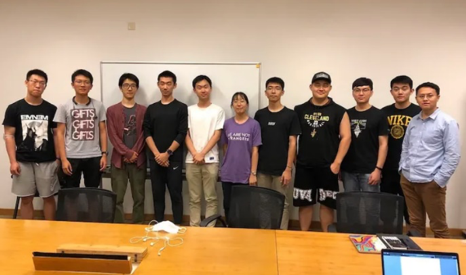
I think the N.E.T. program is unique in many different ways. The most important manifestation of this is in the diversity of its educational methods and the diversity of its student body. Taking our team as an example, our members come from a variety of backgrounds including mathematics, physics, and computer science. This allows us to make effective research progress through an interdisciplinary approach where people have the opportunity to give full play to their respective strengths.
Related news article:
https://research.shanghai.nyu.edu/centers-and-institutes/physics/news/scientists-find-effective-way-manipulate-physical-properties
https://research.shanghai.nyu.edu/centers-and-institutes/physics/news/soft-ferromagnetism-found-oxide-thin-films-nyu-shanghai