



The N.E.T. Program Award Committee is honored to name PhD candidate in Neuroscience Yuhan Lu as a recipient of the 2025 N.E.T. Award for Academic Excellence. Lu graduated this June with a PhD in Neuroscience from ECNU School of Psychology and Cognitive Science and continued on as a Postdoc fellow at NYU Shanghai. He describes the award is “high praise from our research community.”
A member of the Speech, Language, and Auditory Neuroscience Group (SLANG) since 2021, Lu works under the supervision of Co-Area Head of Neuroscience and Associate Professor of Neural and Cognitive Sciences Xing Tian. His research uses electrophysiological recording (e.g., EEG, MEG, and iEEG) to investigate how the brain processes speech and language.
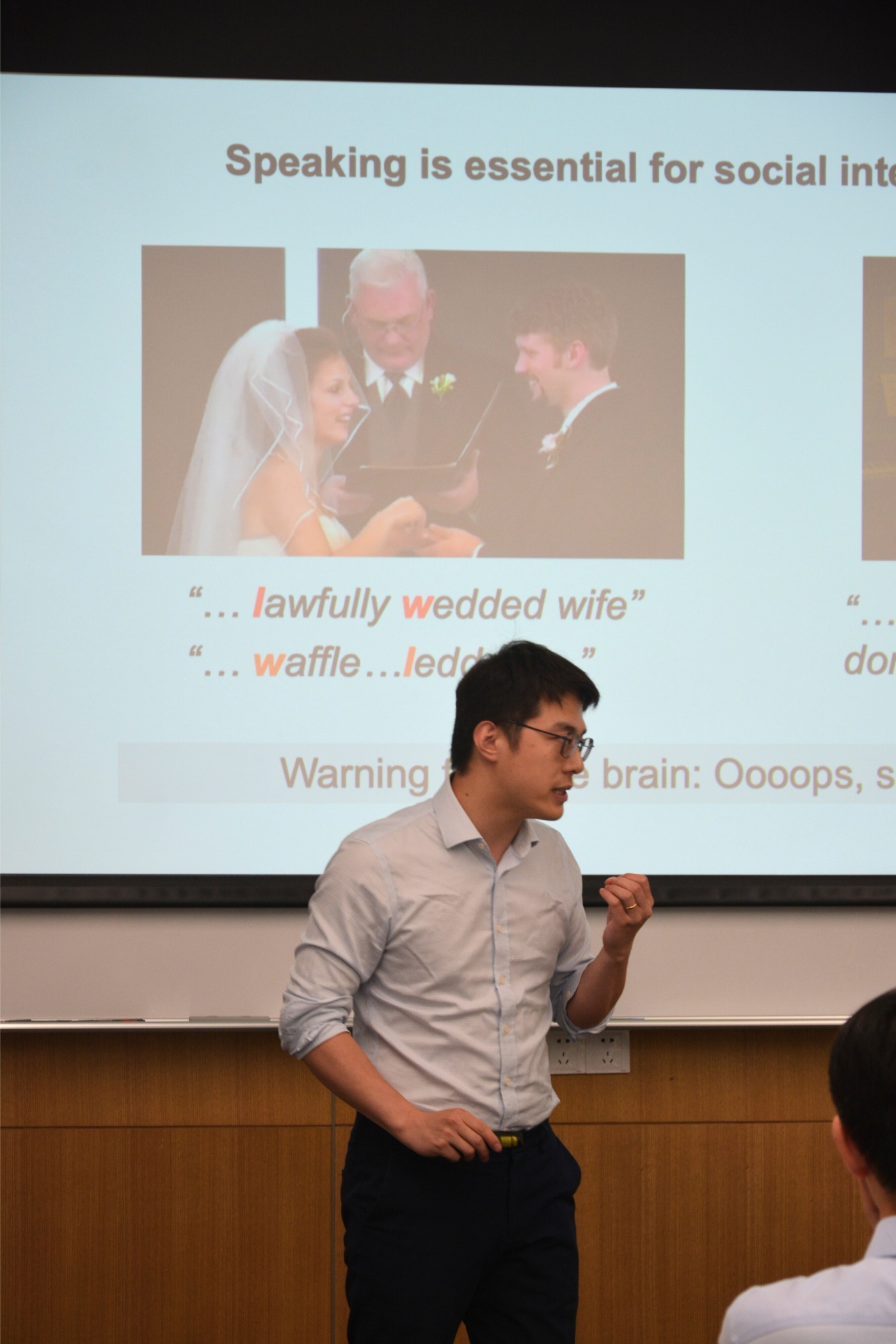
In a recent study, Neural Basis and Computations of Speech Monitoring and Control (currently under peer review), Lu explores how people learn new articulations from past experience. “We wanted to know whether it is the perception of speech errors or the mode of correction that makes us learn new tone, dialects or languages,” Lu explains. By manipulating real-time auditory feedback during speech production, the study found that it is the mode of correction—the brain’s effort to adjust unexpected feedback to match predicted sounds—that enables learning. “Trying to correct an unexpected pitch shift teaches us how to imitate the new language,” Lu says, “rather than it just being the sensory detection of the error.”
Though Lu began his academic path in audiology, his research has since evolved to address foundational questions about how the brain works—questions that straddle practical applications and deep theoretical inquiry. “Similar to a fundamental equation in physics, my generation of neuroscientists have a big dream of achieving a fundamental principle of brain function—something like Einstein’s theory of relativity or Newton’s laws.”
“There’s a lot of similarity between the physical world and the organic world of the brain,” he continues. “If we look at the flow of a river, we may notice periodic and aperiodic patterns. We try to find general rules behind brain activity—why a certain neural population exhibits particular movement under certain conditions.”
At the intersection of neuroscience and philosophy, Lu’s approach is to “right-size” experimental design to explore big-picture questions. “Most brain research is about the relationship between behavior and neural activity—what a population of neurons actually does. But asking deep questions can be very challenging.” He credits Professor Tian for helping him refine his focus: “He’s a true educator. He always encourages me to ask questions and is there to talk things through when I get stuck. I love our conversations—he has immense wisdom in philosophy, psychology, and AI. He shows me how to break big questions into manageable parts.”
Lu says the N.E.T. Program has been instrumental in supporting both his research and his day-to-day academic life. “N.E.T. is very supportive—they help with everything from academic guidance to practical things” He adds, “I love my colleagues. They’re an inspiring group, and we learn a lot from each other through discussion. By comparison, what I know and have read is only a small portion – they show me a larger world.”
The N.E.T. Award Committee congratulates Yuhan Lu on his achievements and looks forward to the continued success of his research.