



The N.E.T. Program Award Committee is pleased to announce PhD student in Neuroscience Xinjing Li as a recipient of the 2026 N.E.T. Award for Research Excellence. Through innovative research on prediction mechanisms in the human brain, Li seeks to answer one of cognitive neuroscience’s most fundamental questions: how the brain anticipates the world before it unfolds.
Working under the supervision of Co-Area Head of Neuroscience and Associate Professor of Neural and Cognitive Sciences Xing Tian, Li investigates how different forms of prediction shape perception. Her research focuses on motor-based and memory-based auditory prediction, combining behavioral experiments, electroencephalography (EEG), and intracranial stereotactic EEG (sEEG) to examine how predictive processes are organized in the brain.
Li’s interest in neuroscience began during her master’s studies, when she became fascinated by the idea that the brain functions as a prediction machine. “We often think of ourselves as simply reacting to the world,” she says. “But in reality, the brain is constantly generating predictions about what will happen next and comparing them against incoming sensory information.” This perspective inspired her to explore how the brain predicts the sensory consequences of our own actions, such as speaking, moving, or playing music.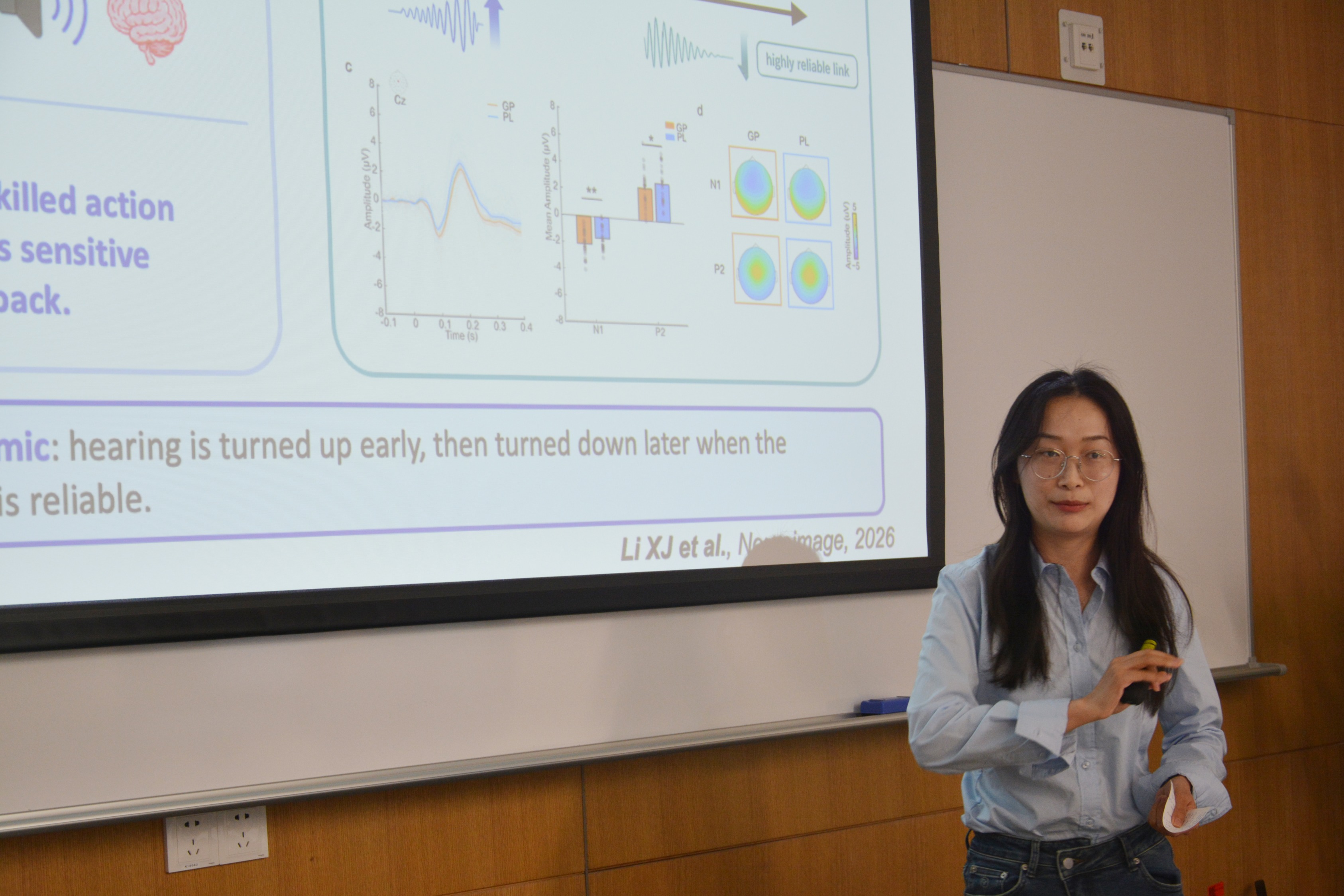
One of Li’s most significant projects addressed a longstanding puzzle in the field. While motor predictions are often believed to suppress sensory processing, many expert behaviors require heightened sensitivity to sensory feedback. To investigate this contradiction, she designed an experimental paradigm using trained pianists, whose precise action-sound expectations provided an ideal model for studying prediction.
Her findings suggest that prediction is neither purely suppressive nor purely facilitative. Instead, auditory processing is enhanced during action preparation, while suppression emerges later and only under highly precise action-sound conditions. The study demonstrates the dynamic nature of prediction and helps reconcile previously conflicting findings.
Building on this work, Li is now using intracranial EEG recordings to investigate where predictive signals originate in the brain and how different neural systems contribute to anticipation and perception.
Li credits Professor Xing Tian with shaping her scientific thinking throughout her doctoral training. “We often spend a great deal of time discussing what a research question is truly asking and whether a particular experimental design can genuinely answer it,” she says. “Through repeated discussions and refinements, I learned how to transform an intuition into a scientifically testable question.”
She also believes the NYU Shanghai–ECNU Joint Graduate Training Program has played an important role in her development by providing access to diverse academic perspectives and interdisciplinary collaboration. Interactions with researchers across psychology, sociology, ecology, physics, and neuroscience have broadened her perspective and encouraged her to approach scientific questions from multiple angles.
Among the many concepts she studies, Li remains especially fascinated by corollary discharge—the brain’s ability to distinguish sensations caused by one’s own actions from those generated externally. “The fact that you cannot effectively tickle yourself illustrates something remarkable,” she explains. “The brain predicts the sensory consequences of your own actions and attenuates them in advance.”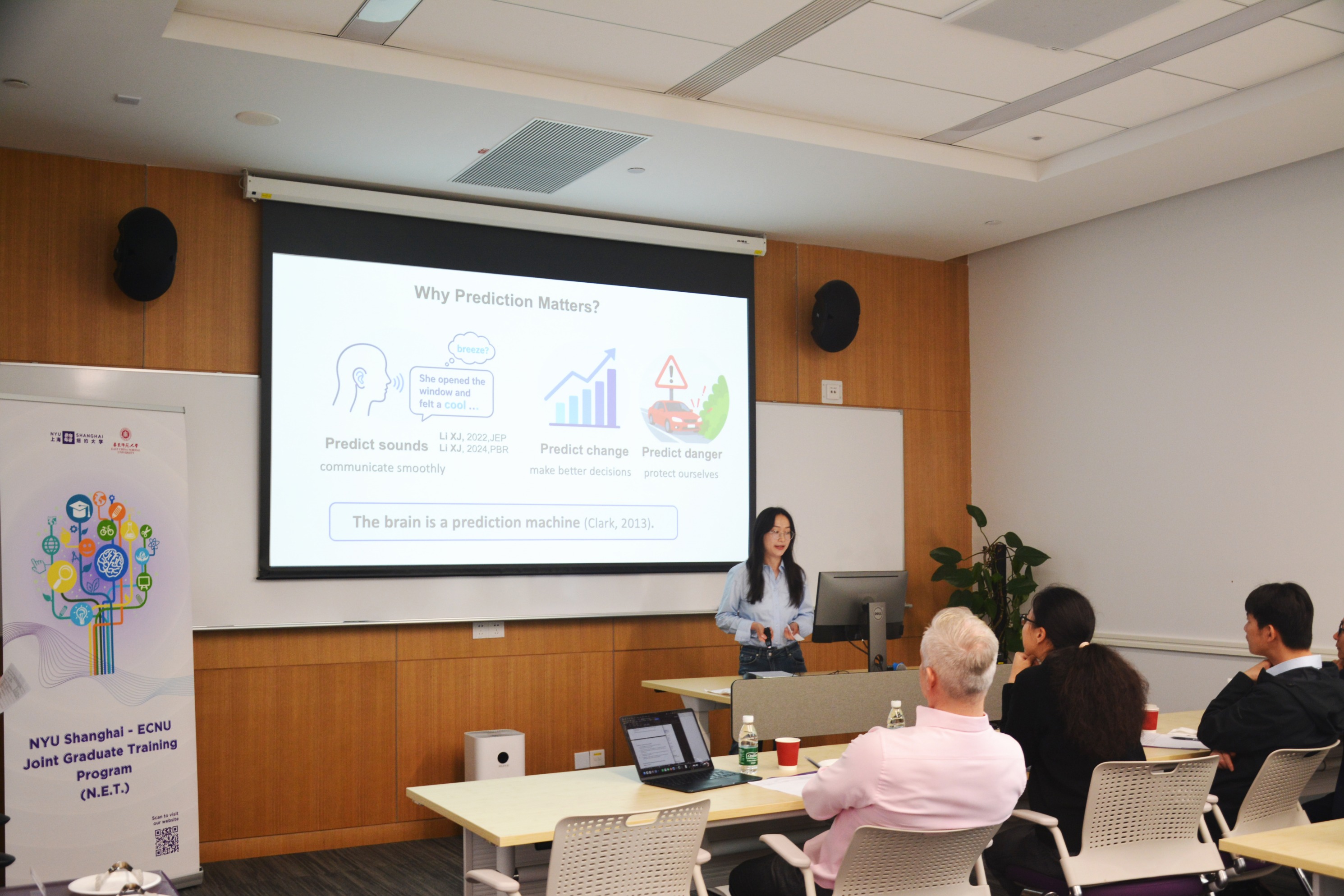
Receiving the 2026 N.E.T. Award for Research Excellence comes at a pivotal stage of Li’s doctoral research. As she analyzes intracranial neural recordings that form a key part of her dissertation, the award provides both recognition and support for the next phase of her work.
The N.E.T. Award Committee congratulates Xinjing Li on this achievement and looks forward to her continued contributions to neuroscience and our understanding of the predictive brain.