



The N.E.T. Program Award Committee is honored to name PhD candidate in Physical Chemistry Kaifang Huang as a recipient of the 2025 N.E.T. Award for Academic Excellence. For Huang, the recognition is “a tremendous validation of my past efforts and a powerful motivator to tackle even greater challenges.”
Kaifang Huang is pursuing his PhD study in Physical Chemistry through N.E.T. program, under the mentorship of Professor John Zhang, Professor of Chemistry at NYU Shanghai. Huang combines physics, chemistry, biology, and AI to investigate the behavior of biomacromolecules, especially proteins.
“What excites me most is the process of solving mysteries that challenge our understanding,” Huang says. His recent work uses molecular dynamics simulations to uncover how protein–ligand binding and dissociation actually happen. “Most people think the tighter a drug binds, the better it works—but that’s not the whole story,” he explains, eyes alight. “The pathway in and out of the binding site matters just as much. We identified an energy ‘barrier’ ligand must cross, proved it, and measured its height. That means drug design should consider both how easily a drug crosses that barrier and how stable it is once bound.” His goal is to translate curiosity into methodological innovation.
Originally drawn to physical and computational chemistry by a fascination with the natural laws underlying physical and chemical transformations, Huang credits Professor Zhang with playing a central role in shaping his scientific approach. “From theoretical derivations to manuscript revisions, Professor Zhang has been involved at every step,” Huang notes. “His guidance has had a lasting impact on my research and academic growth.”
Huang’s interdisciplinary background spans physics, life sciences, and chemistry. “My training helps me integrate physical theory, chemical principles, biological insights, and AI to study complex molecular systems,” he explains. In the lab, this means building atomistic models and simulating them to extract kinetic and energetic insights that can inform fields such as drug discovery.
As a member of the N.E.T. community, he notes the program has been instrumental in supporting both the technical and international aspects of his work. “Being able to use my native language in the lab while presenting in English at N.E.T. seminars gave me both comfort and challenge,” he reflects. High-performance computing resources across NYU New York, Shanghai, and Abu Dhabi campuses have also enabled him to conduct large-scale, GPU-accelerated simulations essential to his research.
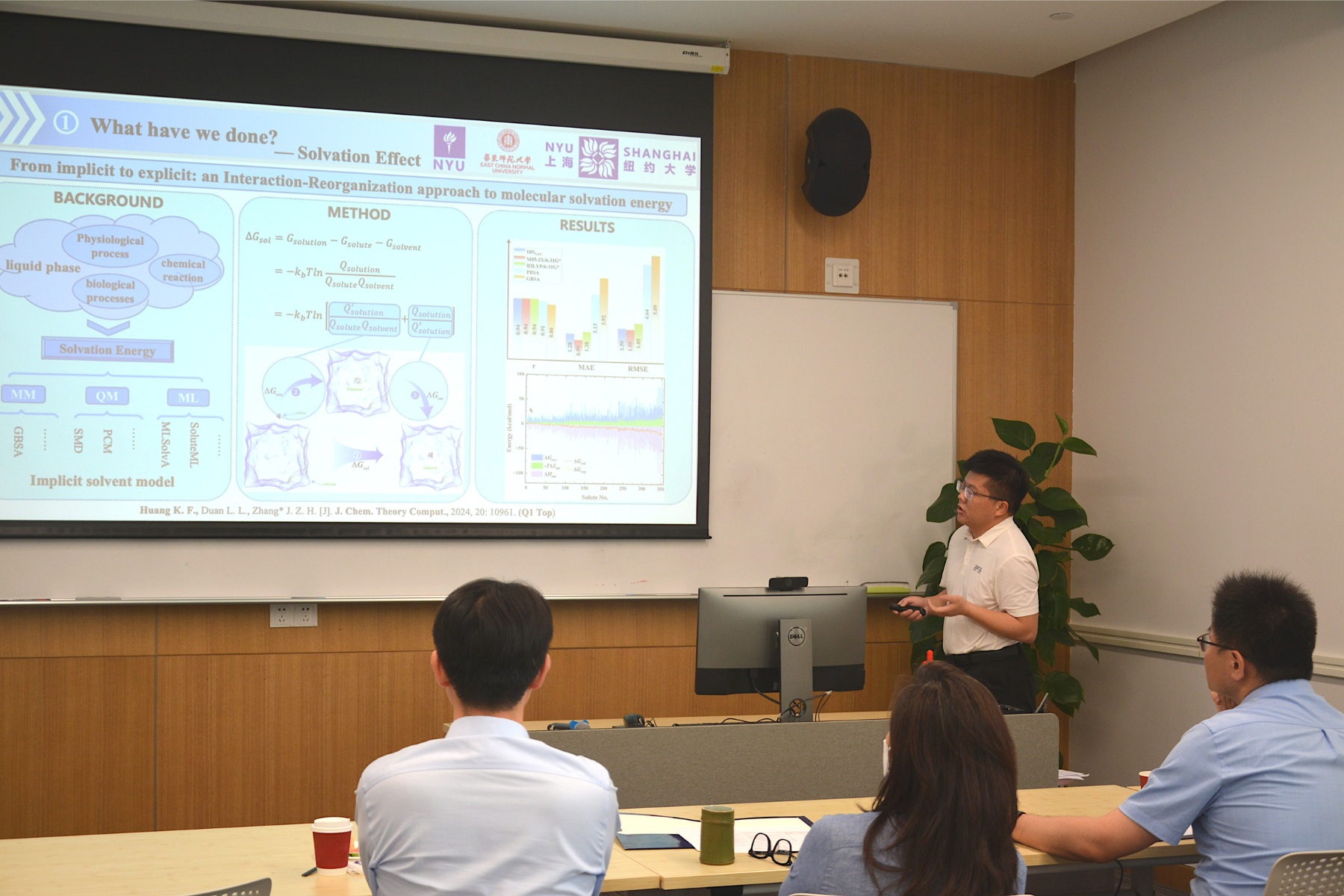
Attending the conferences organized by the NYU-ECNU Joint Research Center in Computational Chemistry at NYU Shanghai, Huang had the chance to engage with cutting-edge research and broaden his academic network. One standout moment for Huang was attending his first English-language academic seminar— “Machine Learning in Molecular Spectroscopy”—which inspired him to bring AI into his own simulations. Later, at the 2024 Shanghai Frontier Symposium on Theoretical and Computational Chemistry, meeting foundational scholars in his field provided new ideas and motivation.
Looking ahead, Huang sees the award as a springboard for the future. “This recognition inspires me to continue asking hard questions and investing deeply in science.” The N.E.T. Award Committee congratulates Kaifang Huang on his achievements and looks forward to the continued success of his work.