



The N.E.T. Program Award Committee is honored to name ECNU Master’s student in Optics Hao Zeng as a recipient of the 2025 N.E.T. Award for Academic Excellence. For Zeng, the award recognition, “encourages me to work harder, and gives me greater confidence to continue pursuing my research with focus and determination.”
Now entering his third year as a Master’s candidate in Optics at ECNU, Zeng conducts research under the supervision of Professor Xiang Sun as part of the Sun Group lab at NYU-ECNU’s Center for Computational Chemistry at NYU Shanghai.
In a study titled “Physics-Informed Neural Network for Quantum Dynamics,” recently published in Molecular Physics, Zeng explores how machine learning tools—particularly physics-informed neural networks (PINNs)—can be used to simulate quantum dynamics in condensed-phase systems. To improve extrapolation of traditional neural network, Zeng notes, “PINNs are useful to us because they incorporate physical laws into the structure of the neural network, which leads to better generalization, accuracy and efficiency.” The team’s findings highlight the potential of PINN’s for quantum dynamics and point toward future developments in neural network architectures inspired by physical principles.
Zeng’s broader research investigates nonadiabatic quantum dynamics in condensed phases, a field that lies at the intersection of Physics, Chemistry, and Materials Science. Using techniques like laser spectroscopy and advanced simulation methods, his work focuses on systems where electronic and nuclear motions are tightly coupled—challenging classical simplifications and demanding innovative modeling strategies.
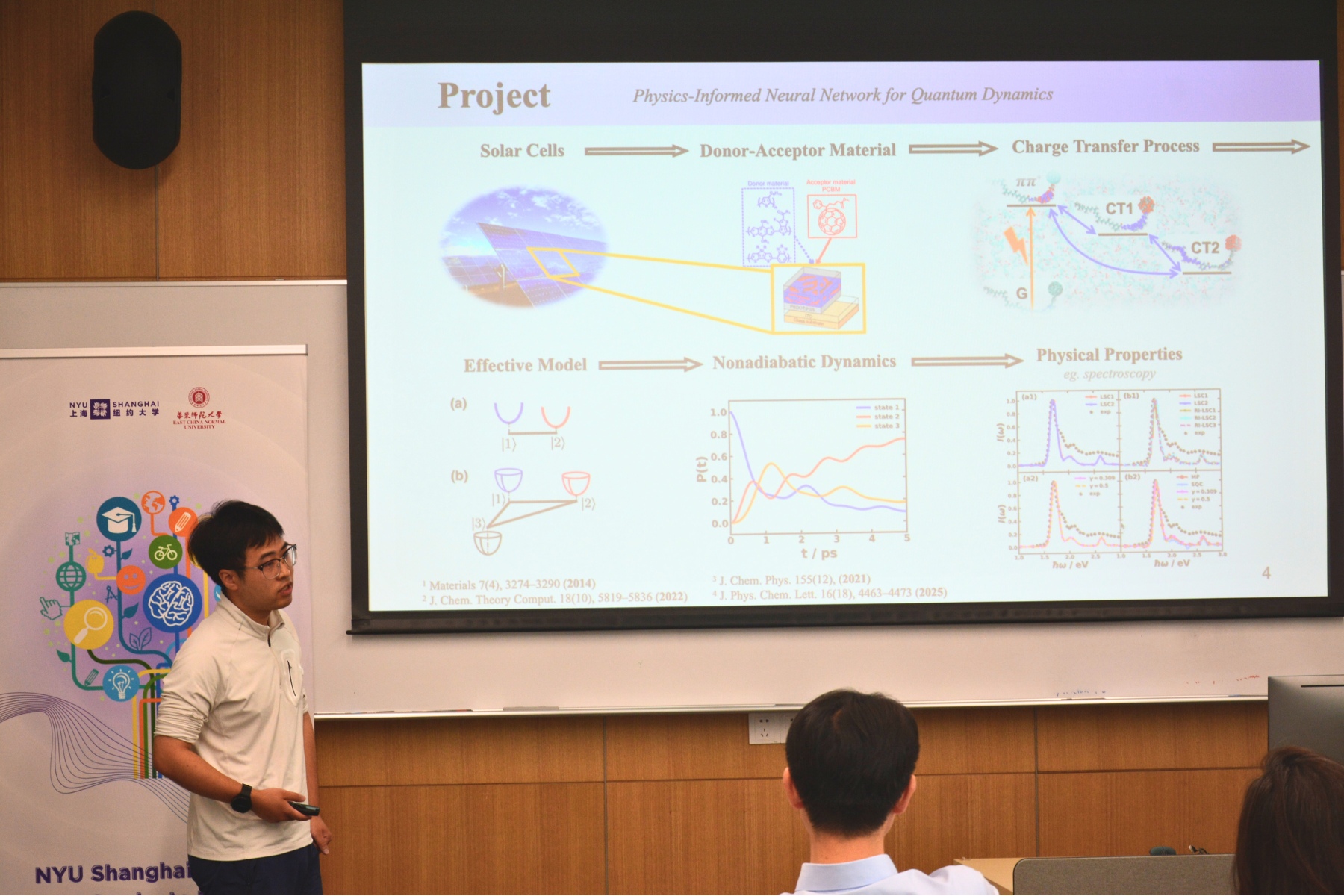
Central to his progress has been the mentorship of Professor Sun. “We typically meet at least twice a week, discussing the detailed progress of my project, solving problems, and sharing ideas about future plans,” Zeng says. “Our group also holds regular meetings where we present our work, receive feedback, and support one another’s development.”
Zeng credits his advisor not only with research guidance but also with providing essential infrastructure and encouragement. “He supports us with abundant computational tools and books, which are crucial for our work,” he says, adding, “he’s an amazing resource.”
Zeng also highlights the unique opportunities afforded by the N.E.T. Program. “We benefit greatly from curricula at ECNU and the high-speed, computational power at NYU Shanghai,” he says. The program’s emphasis on bilingual academic communication has helped him grow as a scholar. “The biggest difference between N.E.T. and other paths at ECNU is the language. We definitely tend to use more English when discussing with our supervisors, presenting in meetings, and writing documents. It’s really helped to improve my English.”
Beyond academics, Zeng has found community and inspiration through N.E.T. “There are many activities that let me meet students from other disciplines and hear about the problems they’re working on,” he says. “I’ve even made friends through these events who go hiking with me. It's a lot of fun!”
The N.E.T. Award Committee commends Hao Zeng’s hard work and determination and looks forward to the continued success of his research.