



The N.E.T. Program Award Committee is pleased to announce PhD student in Statistics Hang Yuan as a recipient of the 2026 N.E.T. Award for Research Excellence. Recognized for innovative research at the intersection of statistics, artificial intelligence, and multimedia generation, Yuan is advancing next-generation generative AI technologies.
Under the supervision of Professor Dan Wang, Yuan focuses on developing advanced generative AI architectures, including Diffusion Models and Large Language Models. His research spans text-driven controllable 3D human motion generation, audio-visual avatar systems, and other multimodal AI applications, with the goal of creating more expressive, controllable, and reliable generative models.
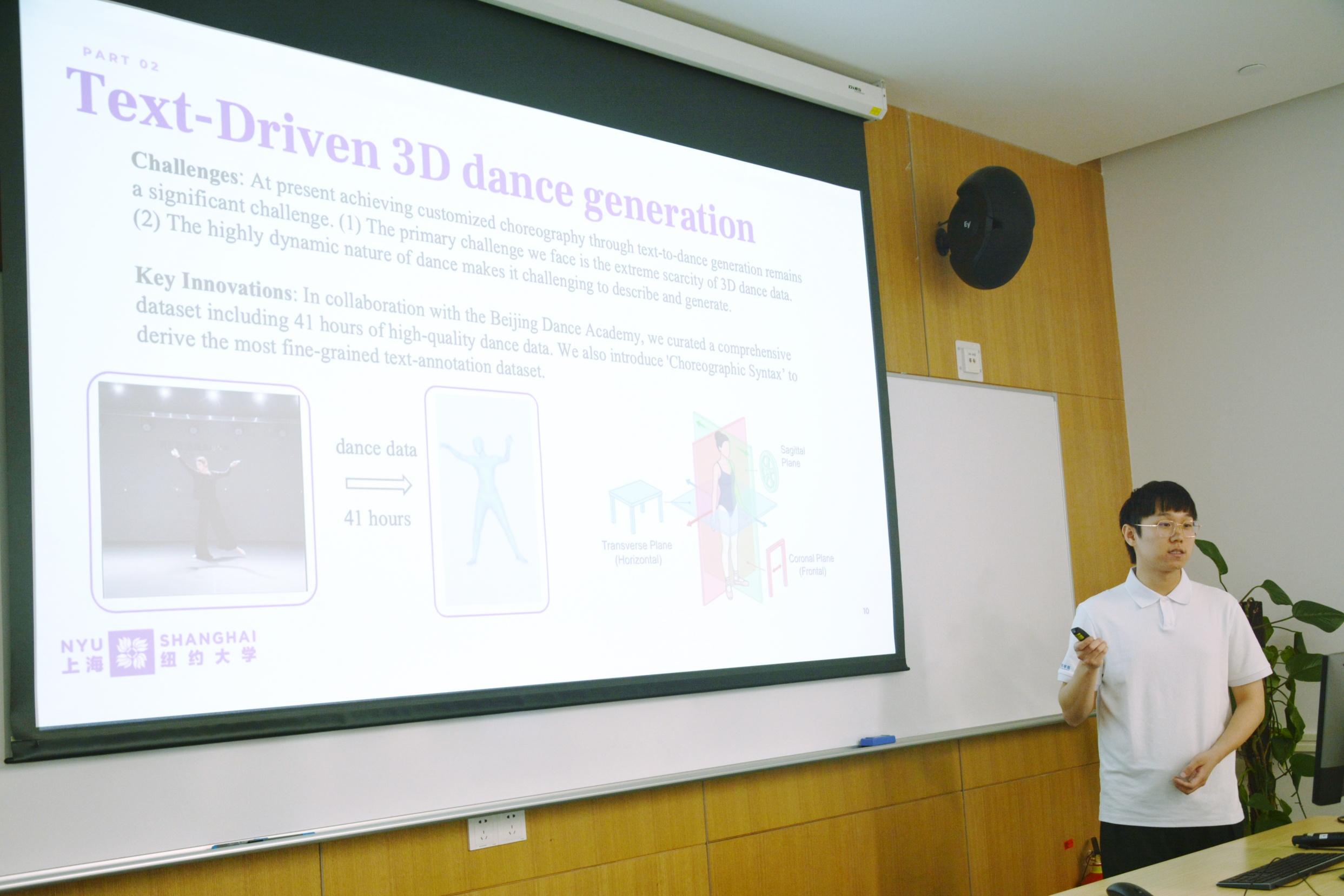
A major focus of Yuan’s research is enabling AI systems to transform natural-language descriptions into realistic human movements. By combining statistical modeling with deep learning techniques, he investigates how machines can learn complex relationships among language, motion, and human expression from high-dimensional multimodal data. His work has broad applications in digital entertainment, virtual reality, human-computer interaction, and AI-powered content creation.
Yuan’s interest in artificial intelligence grew from his strong foundation in mathematics. During his undergraduate studies, he developed a fascination with mathematical reasoning, but it was during his doctoral training in statistics that he discovered his passion for generative AI.
“I was fascinated by the idea that abstract statistical theories could eventually become systems capable of generating realistic human motion or engaging in natural conversations,” Yuan says. “Seeing mathematical concepts evolve into technologies with tangible real-world impact was what truly sparked my passion for this field.”
One of the greatest challenges in Yuan’s research has been bridging fundamentally different forms of information. Developing controllable human motion generation systems requires aligning linguistic instructions with complex three-dimensional skeletal motion data. “Traditional approaches often struggled to capture the nuanced relationship between language and movement,” Yuan explains. “Addressing this challenge required learning across multiple disciplines, collaborating with experts in the arts, and repeatedly refining our model architectures.” The experience reinforced his belief that meaningful innovation depends on both perseverance and interdisciplinary collaboration.
Throughout his doctoral journey, Professor Dan Wang has played a central role in Yuan’s development as an independent researcher. “Professor Wang consistently challenges me to think more deeply about my research,” Yuan says. “Whether working through major journal revisions or exploring new research directions, her guidance has shaped not only my projects but also my identity as a scholar.”
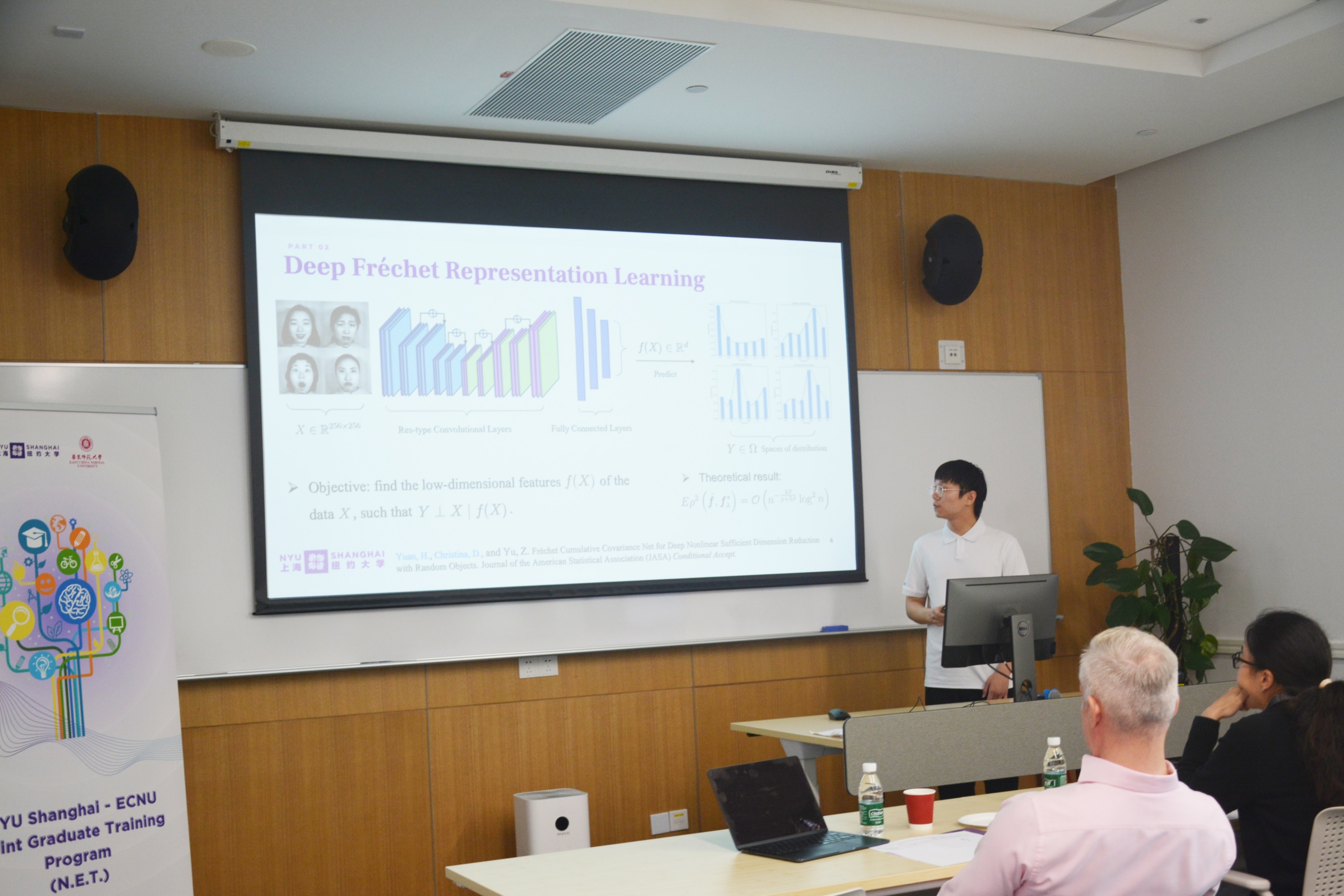
Yuan also credits the NYU Shanghai–ECNU Joint Graduate Training Program for fostering interdisciplinary collaboration. Working with researchers from diverse fields has broadened both his perspective and the impact of his research.
Looking ahead, Yuan hopes to continue exploring both the theoretical foundations and practical applications of generative AI. He is particularly interested in multimodal world models as well as the statistical foundations of generative models, including questions of uncertainty, reliability, and stronger statistical guarantees for increasingly complex AI systems.
Receiving the 2026 N.E.T. Award for Research Excellence serves as both recognition of his past accomplishments and motivation for future discoveries. “This award is a meaningful affirmation of my research efforts,” Yuan says. “It gives me confidence to pursue more ambitious projects and continue pushing the boundaries of what generative AI can achieve.”
The N.E.T. Award Committee congratulates Hang Yuan on this achievement and looks forward to his continued contributions to statistics, artificial intelligence, and interdisciplinary innovation.