

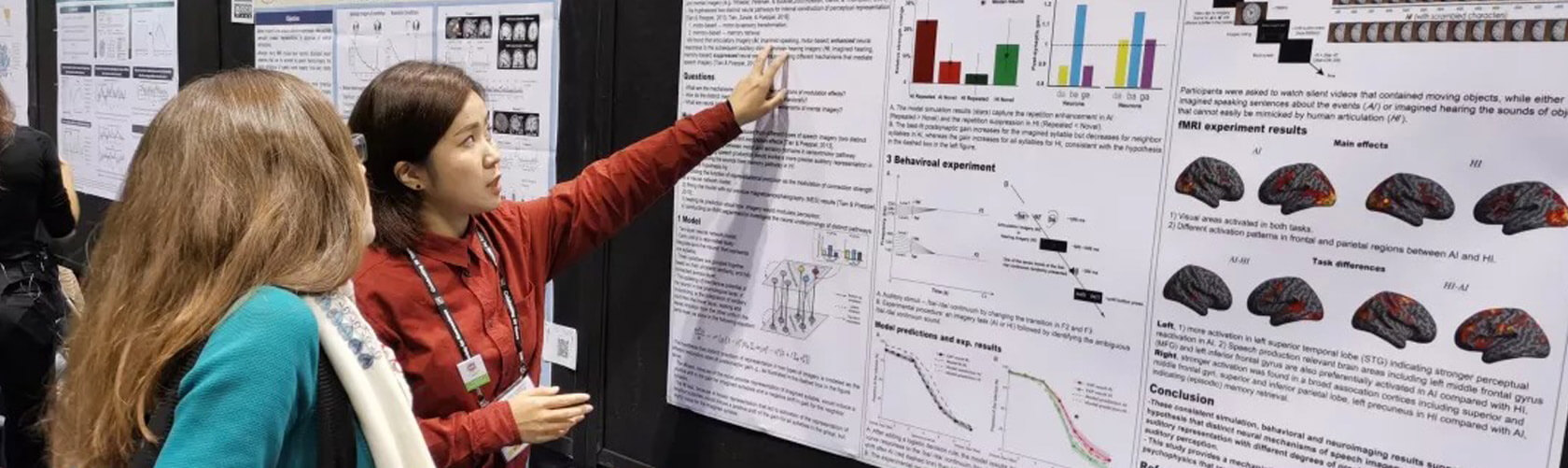
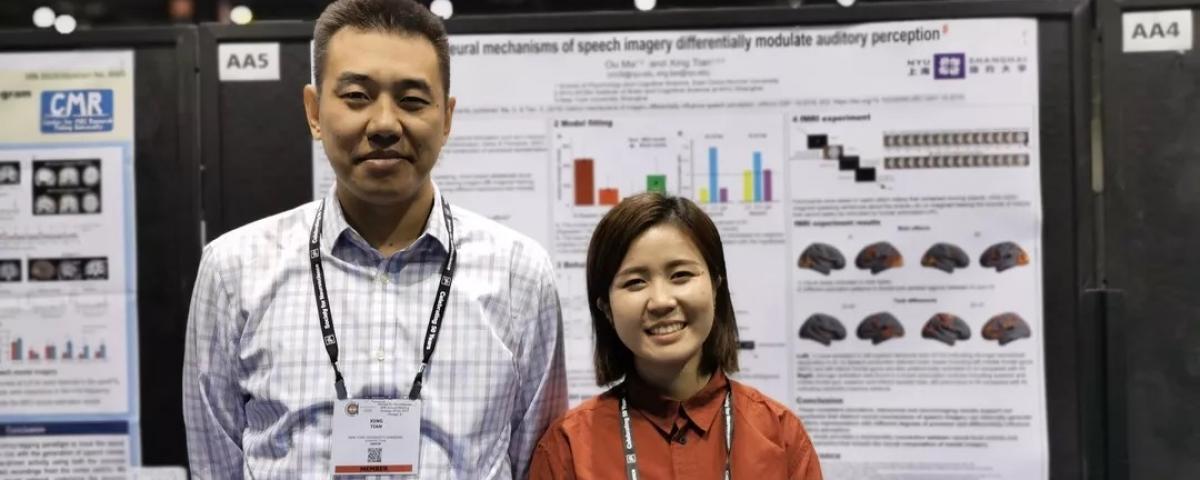
In October 2019, 30,000 neuroscience academics from over 80 countries around the world gathered in Chicago, Illinois, USA for the 49th annual meeting of Society for Neuroscience. Two of the guests selected to present their research at this top international neuroscience conference were Ma Ou, a graduate student at the NYU-ECNU Joint Graduate Training Programing, and her advisor Xing Tian, Assistant Professor of Neural and Cognitive Sciences at NYU Shanghai, who had at the time recently co-published a study on the effects of imagination on cognition in eNeuro, an open access, online journal by the Journal of Neuroscience.
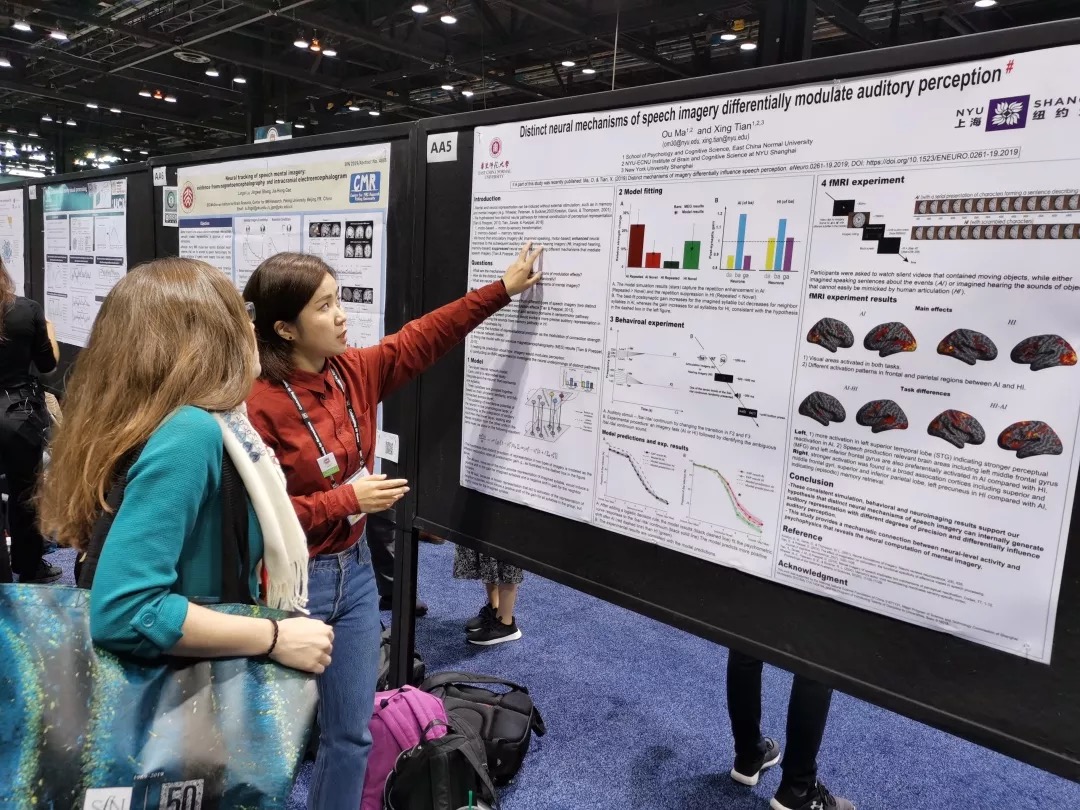
Ma Ou presenting their latest research to attendees at the annual Society for Neuroscience conference.
“NYU has a long history of excellence and strength in the field of neuroscience. With the strong research strength of NYU, NYU Shanghai is able to obtain more resources for research collaboration,” Tian said. “On the other hand, ECNU is one of the best universities in China, especially in the fields of psychology and cognitive neuroscience in Shanghai. Therefore, this joint program is beneficial for research as it integrates and shares the rich resources of the two universities.”
The eNeuro publication served as a follow-up to Tian’s research dating back to 2010, when he began studying how the human brain’s cognitive neural mechanisms affect how we use our imaginative abilities to process external information.He and his research group went on to publish a paper in 2013 that proposed two verbal imagery processes based on different cognitive processing mechanisms.
One process includes imagining ourselves speaking and being clear in our mind about what we’re going to say versus recalling a quote we heard someone else say, from memory. This process is not very clear, since it’s often affected by other factors, but the two types of imagery–based on different neural pathways and mechanisms in the brain–have different degrees of impact on human cognition.
Due to the novelty of its topic and methodology, the study went through trial and error during its research and publishing process, but the duo supported each other with their given skill sets. Tian, familiar with mathematical and physical models,proposed a neural network model to prove his 2013 hypothesis on the two types of imagery. And Ma, with an undergraduate background in psychology, specializing in behavioral experimental design, developed the experiments to prove the model’s validity.
“My role as an advisor is to bring out her strengths to solve problems, and we help and learn from each other in the process,” said Tian, who described their collaboration as more like coworkers than teacher-student.
In the experiment, subjects were asked to imagine themselves or others saying “ba” or “da.” They then would hear an ambiguous sound between “ba” and “da,”, and would need to determine which pronunciation they heard. In the meantime, experimental conditions were also entered into the model to compare results from the model with real results.
It was found that when imaging their own pronunciation, people were more likely to think that the pronunciation they heard afterward was the one they imagined, because their imagination was more clear. This tendency was less significant when imagining other people’s pronunciation, due to the relatively vague imagination. This unexpected behavioral result distinguished different modes of imaginative processes, which were consistent with the expectations of the model and supported the proposed hypothesis.
“Professor Tian was very kind, patient, and always considered our actual needs,” said Ma, who was part of the joint program for three years.
“The biggest difference between this joint program and other programs is that it shares the resources of ECNU, NYU Shanghai, and NYU,” Ma added. “Our research facilities at ECNU are well-equipped, and at the same time, we also attend classes at NYU Shanghai, make use of the bibliographic database, enjoy various shared lectures and conference resources, and have international exchange and research collaboration opportunities, which have greatly expanded my professional horizon.